

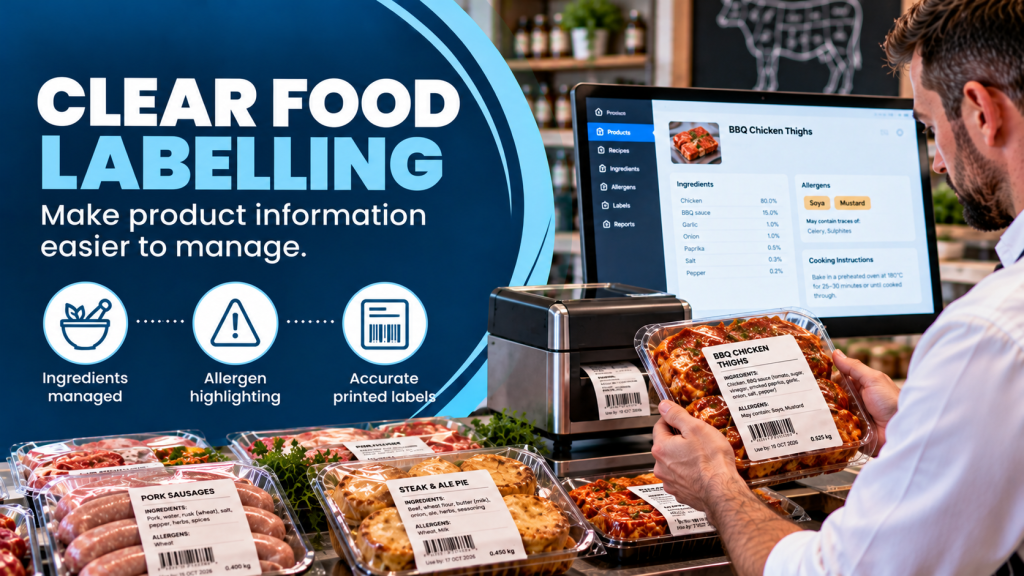
Clear food labels help customers understand what they are buying. They also help staff identify products, manage stock and provide important information at the point of sale.
For butchers, farm shops, delicatessens and other food retailers, labelling can become complicated when products contain several ingredients or require different dates, prices and barcodes.
Having the right weighing equipment and software can make the process easier to manage.
1. Give customers clear product information
A food label can do much more than display a price. Depending on the product and how it is sold, it may need to include the product name, ingredients, allergen information, a barcode or relevant date information.
For example, a butcher selling prepared sausages, marinades or ready-to-cook meals may need to manage more product information than someone selling fresh cuts over the counter.
Labels should be clear, legible and appropriate for the type of food being sold.
The Food Standards Agency provides guidance on food labelling and packaging, including the information food businesses need to provide.
2. Make allergen information easier to manage
Allergen information is particularly important when preparing and selling products containing multiple ingredients.
For prepacked food, and food prepacked for direct sale where the relevant rules apply, labels must include the required ingredient information, with allergenic ingredients emphasised in the ingredients list.
This can be a challenge for businesses making their own products. Recipes change, suppliers update ingredients and new products are introduced.
Dimension Pro software, supplied by South Coast Systems, includes a recipe builder that lets businesses create recipes, assign them to products and record ingredient percentages. Allergens in recipe information are automatically highlighted within the system.
This can help staff manage ingredient records and prepare product information more efficiently. However, businesses must still check that recipes, supplier information and printed labels are accurate.
Read the Food Standards Agency’s guidance on prepacked for direct sale food labelling for more detail.
3. Reduce repetitive product updates
Product information changes regularly. Prices may increase, recipes may be adjusted and new products may need to be added.
Updating each scale or label template separately can take time, especially when a business operates several counters or locations.
Dimension Pro allows businesses to manage product details such as prices, barcodes, use-by dates, promotions, cooking instructions and recipes through its product maintenance tools.
It can also update compatible Avery Berkel system scales, helping businesses keep supported product information connected across their setup.
Explore Dimension Pro to learn more about its product management features.
4. Choose weighing equipment that suits your labelling needs
Different food businesses have different requirements. A busy butcher’s counter may need fast weighing and label printing, while a production room may need to label batches of prepared products for collection or delivery.
South Coast Systems supplies Avery Berkel scales with options for weighing, receipt printing and product labelling.
For example, the Avery Berkel XTi range includes models designed for retail environments where labels or receipts are required.
When choosing equipment, consider the products you sell, the information your labels need to display and whether you want the scales to connect with back-office software.
5. Keep labels consistent across your business
If your team uses different processes to create labels, product information can become inconsistent.
A connected system can help staff work from centrally managed product records and send supported details to compatible scales.
This is particularly useful when you have multiple weighing stations or prepare products in a separate area before they reach the counter.
Dimension Pro can also support wider tasks such as stock control, order processing and reporting. This means product information can form part of a more connected workflow rather than being managed in isolation.
6. Review your labelling process regularly
Even with suitable software, regular checks remain important.
Review product records when ingredients or suppliers change. Check that labels match the current recipe and confirm that staff understand the process for updating product information.
It is also worth reviewing whether your current equipment meets your needs. If labelling takes too long or updates require repeated manual work, a connected setup may be worth considering.
Find a labelling solution that works for your business
Accurate food labelling relies on good information, consistent processes and suitable equipment.
For butchers, farm shops and other food retailers, weighing scales connected to product management software can help make routine labelling tasks easier to manage.
South Coast Systems supplies Avery Berkel weighing equipment and Dimension Pro software to support food retail and wholesale businesses.
Looking to improve your food labelling process? Browse the Avery Berkel range or contact South Coast Systems to discuss your requirements.