

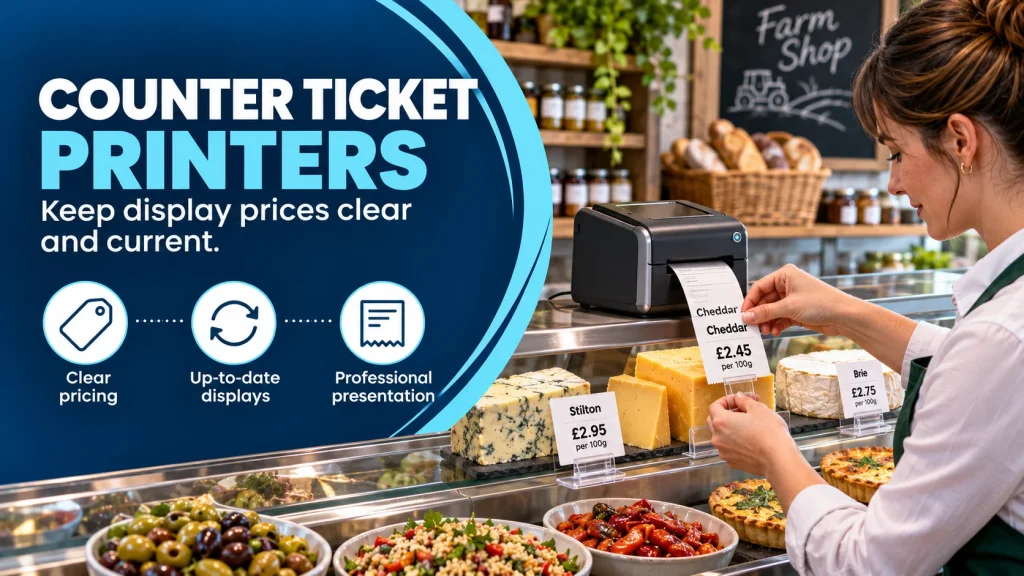
Clear counter tickets help shoppers identify products and understand prices without repeatedly asking staff. For a butcher, delicatessen or farm shop, a counter ticket printer is most useful when it fits the way products and prices are already maintained.
Decide what each ticket needs to say
Start with the information shoppers look for: a recognisable product name, an unambiguous price and the right unit of sale. Some counters also need a description, origin statement or other product information. Keep the layout readable from a normal viewing distance. A ticket that can hold every field is not necessarily one customers can scan quickly.
Food information rules depend on the product and how it is sold. The Food Standards Agency’s allergen guidance is a useful starting point when planning customer information. Check the requirements for your own products before treating a counter ticket as a substitute for another label or staff process.
Plan for price changes
Ask how a changed price reaches the printed ticket and the till or weighing scale. If each system is updated separately, assign a person to check that the displayed and charged prices match. For shops with frequent promotions or several branches, the time spent replacing tickets can be more important than the printer’s headline speed.
South Coast Systems supplies the Symeyo counter ticket printer. If you are comparing printed tickets with digital displays, read our separate guide to electronic shelf labels for food retailers. The right choice depends on your number of products, frequency of changes and the appearance you want at the counter.
Test the whole process, not just the print
- Can a colleague find and print a ticket for a new product without retyping it?
- Does the print remain readable under your counter lighting?
- Are ticket sizes and holders suitable for your displays?
- What happens when a price changes or a ticket is damaged?
- Can staff spot when the displayed ticket is out of date?
Printed tickets or electronic labels?
Printed tickets are familiar and can work well when a display changes occasionally. They still need someone to remove superseded tickets and check that the counter matches the current price list. Electronic shelf labels may suit shops that update many prices often, but they bring their own setup and maintenance questions. Count your typical weekly changes before comparing costs; a small display and a large multi-department shop have different needs.
Whichever approach you choose, decide where the authoritative price lives. A beautifully printed ticket is not useful if the scale or till charges something else. Include one price-change test in staff training and ask the team to report any mismatch immediately.
What should a sample prove?
Test a short name, a long name, a promotion and a product sold by weight. Put the printed samples into the actual holders under your shop lighting. Check contrast, smudging and whether a customer can tell the unit price from the total pack price. If a ticket must carry additional food information, review the exact legal requirement for that product rather than squeezing essential text into an unreadable space.
Ask to see a sample ticket for your longest product name and a real price update. That small test exposes layout and process problems before you buy. Request a quote with your ticket sizes and counter requirements.