
Changing prices and updating product information can take up valuable time in a busy food retail business. For butchers, farm shops, fishmongers and delis, keeping every display accurate is an important part of the daily routine.
Traditional paper labels need to be printed, replaced and checked whenever details change. When you have a large product range, these small tasks can quickly add up.
Electronic shelf labels offer an alternative. But what are they, how do they work, and could they benefit your business?
What Are Electronic Shelf Labels?
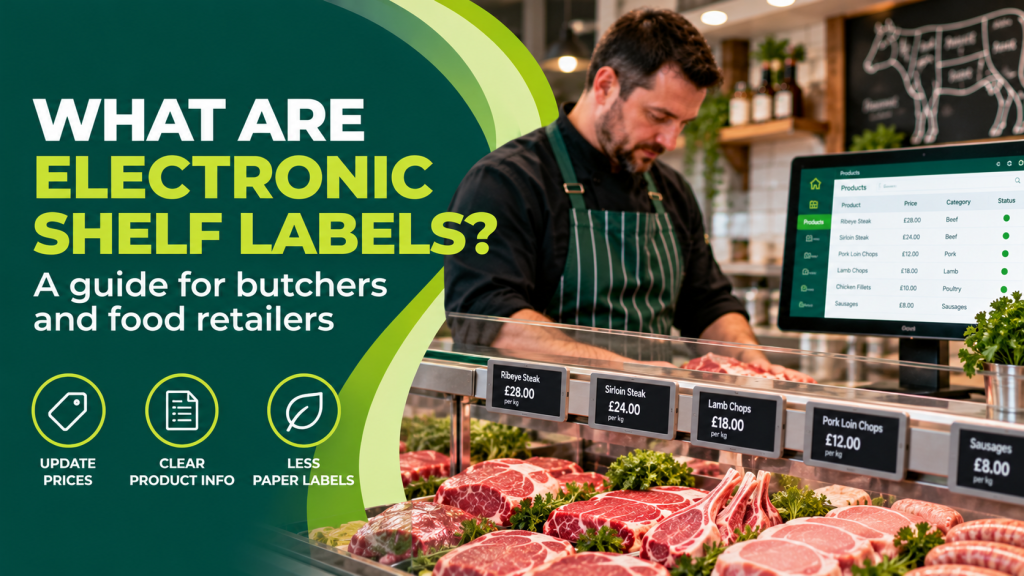
Electronic shelf labels (ESLs) are small digital displays used to show prices and product information at the point of sale.
Instead of printing a new paper label whenever a price changes, compatible electronic labels can be updated digitally through a connected system.
Depending on the model and setup, they can display information such as:
- Product names and descriptions.
- Prices and prices per kilogram.
- Allergen information.
- Promotional messages.
- Barcodes, QR codes and logos.
For food retailers, this can provide a more flexible way to manage information across shelves, counters and product displays.
South Coast Systems supplies electronic shelf labels designed for businesses including butchers, greengrocers, delicatessens, farm shops and fishmongers.
1. Update Prices More Easily
Prices can change for several reasons, including supplier costs, seasonal availability and changes to your product range.
With traditional labels, each change can involve printing new cards, removing the old ones and checking that the replacements are correct.
Electronic shelf labels can simplify this process by allowing supported price changes to be sent to compatible displays through the connected software.
South Coast Systems’ electronic shelf labels can be controlled through Dimension Pro. When supported product information or prices are changed in the software, the relevant information can be sent to the labels.
This can reduce the need for repeated manual updates and help staff spend less time changing display cards.
2. Keep Product Information Consistent
Keeping prices consistent across your business is important, particularly when you manage a wide selection of products.
If product details are maintained separately across different systems, there is more opportunity for information to become outdated or inconsistent.
A connected setup can help reduce this problem by allowing product information to be managed centrally.
For example, Dimension Pro can be used to manage product details and pricing, while compatible electronic shelf labels display the relevant information to customers.
This approach can be particularly useful for shops that regularly update prices or manage a large number of products.
However, businesses should still check that the information displayed is accurate and meets the requirements that apply to their products.
3. Reduce Paper Labels and Repetitive Tasks
Paper labels are familiar and can work perfectly well for many businesses. However, replacing them repeatedly can create extra work.
Staff may need to print labels, cut them to size, laminate cards or physically replace displays whenever information changes.
Electronic shelf labels provide another option by allowing compatible displays to be updated digitally.
This may help reduce the amount of time spent producing and replacing paper cards. It can also reduce the need for printing materials associated with frequent price changes.
The overall benefit will depend on the size of your product range, how often information changes and how your current processes work.
4. Display More Than Just Prices
Electronic shelf labels can offer more flexibility than a basic price card.
Depending on the display and configuration, they can show product names, prices, allergen information, sales messages and other supported details.
For example, a butcher may want to display the product name and price per kilogram clearly beside a particular cut of meat.
A farm shop might use its labels to display product descriptions or promotional messages.
Having the right information available at the point of sale can help customers understand what they are buying.
Remember that electronic shelf labels do not automatically replace every legal labelling requirement. Food businesses must still provide the information required for their products in the correct format and location.
The government’s food labelling and packaging guidance explains the general requirements for food information.
5. Consider How Electronic Shelf Labels Fit Into Your Existing Systems
Before investing in electronic shelf labels, it is worth reviewing the systems you already use.
Think about how you currently manage product information, how often prices change and how much time your team spends updating displays.
You should also check compatibility between the labels and your existing software.
South Coast Systems offers electronic shelf labels that can be controlled through Dimension Pro, helping connect product information management with in-store displays.
You can explore the Dimension Pro software to learn more about its product management and integration features.
The right setup will depend on your shop, the equipment you use and the information you need to display.
Are Electronic Shelf Labels Right for Your Business?
Electronic shelf labels may be worth considering if your business regularly changes prices, manages a wide product range or spends considerable time replacing paper display cards.
They can provide a more flexible way to update supported information and help connect your product management processes with your shop displays.
However, they are not essential for every retailer. If your prices rarely change and your current process works well, traditional labels may still be the most practical option.
The important thing is to understand where your team spends time and whether a different approach would offer a genuine benefit.
Explore Electronic Shelf Labels With South Coast Systems
Managing product information does not need to involve unnecessary repetition.
Electronic shelf labels offer food retailers another way to display prices and product details, while compatible software can help simplify how those details are maintained.
South Coast Systems works with food retailers and wholesalers to provide weighing, labelling and business management solutions.
If you are looking to update your shop displays or connect your product information with your existing systems, explore the SCS electronic shelf labels to find out more.